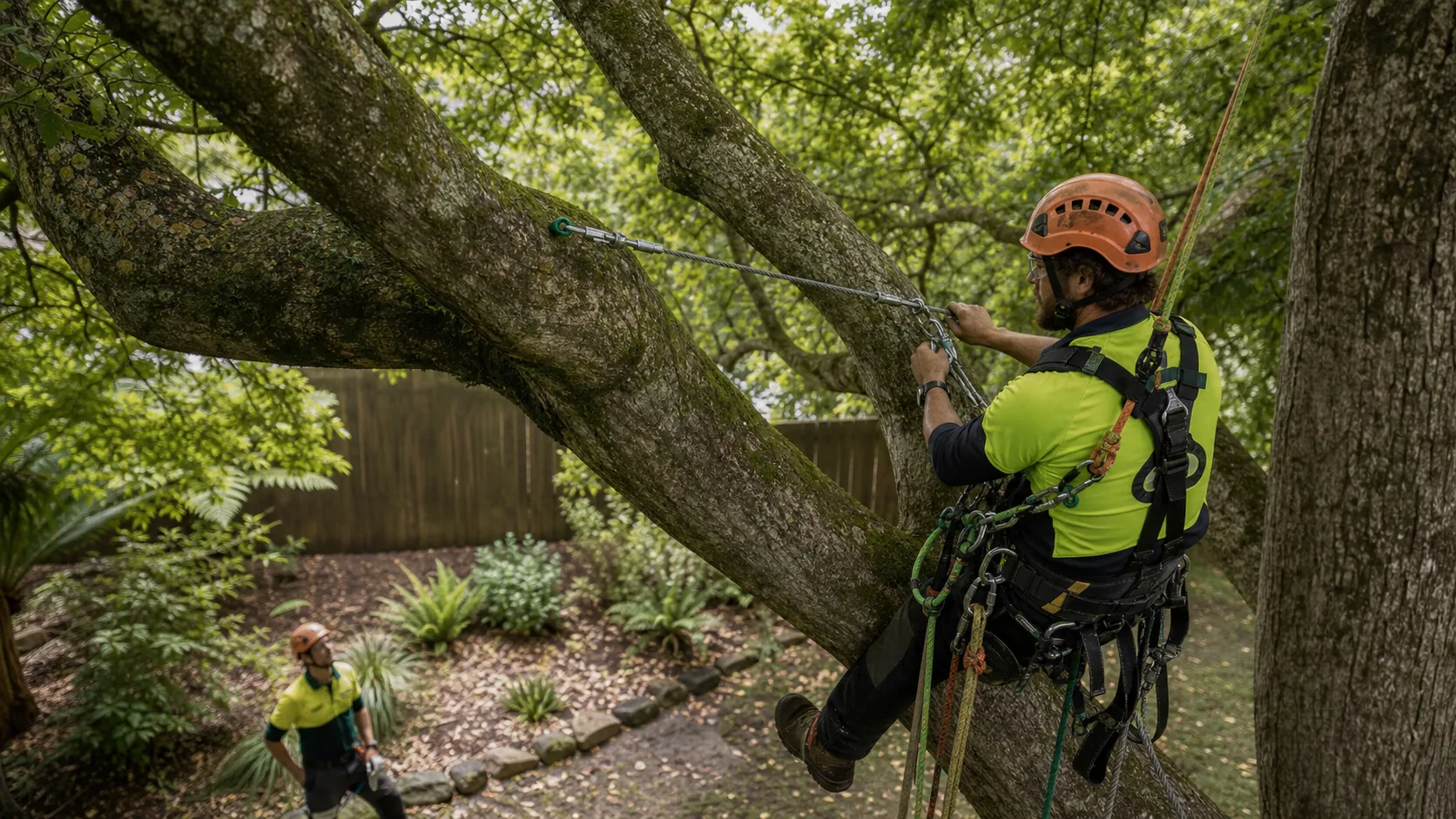
Assess structure and surrounding targets.
Tree Cabling and Bracing Rotorua
A property can become harder to use when included unions or competing stems and heavy limbs with limited support. Waiting can make access, presentation or future maintenance more complicated, particularly when the work is above comfortable ground level or close to buildings. Our Rotorua Tree Cabling and Bracing service starts with the concern you can see and the result you want, rather than assuming the same treatment suits every tree or site.
Our arborists inspect the work area, surrounding structures, vegetation and practical access before recommending a clear scope. The service can reduce movement or load at selected weak unions when an arborist determines that support is appropriate and the tree remains suitable for retention. You receive an explanation of what can be done, what material will remain or be removed, and how the property will be left. That makes it easier to compare options and arrange work that is proportionate to the site.
Free, No-Obligation Quote
Get a Free Quote
Tell us about your property and we'll get back to you with a clear price, usually within one business day.
When Do You Need Tree Cabling Services in Rotorua?
A closer look is worth arranging whenever any of the following start to stand out on the property:
- Included unions or competing stems.
- Heavy limbs with limited support.
- Previous branch failure.
- A valued tree where removal is not the first preference.
These signs do not always mean the largest or most disruptive option is necessary, but they do deserve attention before the concern spreads or affects normal use of the property. Rotorua sites vary in access, ground conditions and exposure, so photographs can help with an initial conversation but do not replace seeing the work area. Our team considers what is changing, what is within reach of people or structures, and whether another service should be coordinated at the same time. If there is an immediate hazard, keep people clear and call for advice instead of trying to cut, move or test the material yourself.
What Our Cabling Team in Rotorua Look Into
We begin by confirming the objective and inspecting the tree, vegetation and work zone, then work through a sequence planned around this property:
Consider pruning and other options.
Specify a suitable support system.
Install from a secured climbing position.
Set an inspection and maintenance plan.
Equipment is selected after access, branch or material size, ground conditions and nearby property have been considered. Where people, vehicles or shared areas could be affected, the crew establishes a controlled work zone before cutting or machinery starts. Before leaving, we check the agreed result, remove the specified debris and explain any monitoring or follow-up that remains useful. The method is adapted to the site; it is never treated as a hazardous do-it-yourself procedure.
Rotorua Tree Bracing for Property Managers
A well-planned job can provide real, practical results:
Reduced Liability Risk
Weak or split branches pose a genuine safety risk on managed properties. Cabling and bracing reinforce structurally compromised trees, reducing the chance of failure and helping protect you from liability claims tied to tree-related property damage or injury.
Preserve Mature Trees
Removing a mature tree is costly and changes a property’s character overnight. Bracing allows valuable, established trees to be retained safely, preserving landscaping value and tenant appeal without resorting to full removal for manageable structural issues.
Cost-Effective Long-Term Solution
Bracing is typically far more affordable than emergency removal or storm-damage repairs down the line. Addressing structural weaknesses proactively helps property managers avoid unplanned costs and budget more predictably for ongoing tree maintenance across a portfolio.
Minimal Disruption to Tenants
Bracing work is generally quick and non-invasive compared to removal, meaning less disruption to communal areas, parking, or tenant access. Our team schedules work efficiently to keep disturbance to residents or commercial occupants to an absolute minimum.
Documented Assessments for Records
We provide clear documentation of the tree’s condition and the bracing work carried out, giving property managers a paper trail for insurance, compliance, or body corporate records. This supports due diligence across multi-property portfolios.
Ongoing Monitoring Options
For property managers overseeing multiple sites, we offer scheduled reassessments to monitor braced trees over time. This ensures early detection of any changes in tree health or structural integrity, keeping your properties safe and compliant long-term.
Support work is worth considering when a tree is genuinely worth keeping and the structural concern is specific rather than general decline. You end up with limb movement managed at the unions that matter, a documented reason for retaining the tree, and a clear date for the next inspection. Where the assessment also points toward arborist reports or tree pruning, we can set out both options side by side. Can a Split or Heavy Branch Be Supported Instead of Removed? covers how support systems are specified, or send the team details and photographs to arrange an assessment.
Tree Cabling and Bracing FAQs
Still deciding what the property needs? These answers cover the questions customers usually raise before arranging an assessment.
Ask us about your propertyHow do I know whether tree cabling and bracing is right for my property?
Start with the result you need and the condition of the site. We assess included unions or competing stems, heavy limbs with limited support and previous branch failure, then explain whether this service, a lighter intervention or another form of tree care is the sensible option.
What happens during a tree cabling and bracing visit?
The crew confirms the agreed scope, checks access and nearby hazards, protects the practical work area and completes the job in controlled stages. Material handling and the final tidy-up are included in the plan so the expected site finish is clear.
Can you carry out this work on rental or commercial property?
Yes. The service can be planned for owners and managers seeking an assessed retention option for mature trees with specific structural concerns. We confirm who can approve the work, how occupants or site users will be affected, and what access arrangements are needed before booking the job.
What affects the price of tree cabling and bracing?
Pricing reflects tree size and access, number of support points, hardware and climbing requirements and inspection or pruning work needed. A site assessment lets us see those details and provide a scope based on the actual work rather than an unreliable one-size-fits-all figure.
How should I prepare before the arborists arrive?
Keep the area beneath the canopy clear and provide any history of cracking, branch loss, earlier pruning or installed supports.